The New Cuba

Jauretsi on Cuban Affairs, Youth Culture, Music, Art… and everything in between

The TV in Cuba

During broadcast hours, all TVs in Cuba are on, no matter if they are being watch or just serving as background noise. Simone Lueck is a Los Angeles based photographer originally from St. Paul, Minnesota who visited Cuba and captured TV culture, for better or worse. The photo essay is a hardcover 80 page book.

The actual television sets are outdated relics imported from America or Russia close to twenty years ago. Convulsing static pictures in off-color hues, the sets are jury-rigged with computer parts and other discarded technological talismans; they are adorned like religious altars.

In her words:

It happened by chance. In 2000, I tagged along with a good friend on a two-week trip to Cuba. I took my 35mm camera and a bunch of film. The first thing I noticed in Havana was that the city was dark at night. There were no streetlights, porch lights or living-room lamps. It was pitch black except for the faint colorful glow spilling out of open doors everywhere, and it came from the TVs. The light captivated me. For the next two weeks I wandered around, slipping in and out of strangers’ living rooms. Each time I came across an open door and a TV set, I asked if I could take a picture of it. The answer was always yes. Nobody seemed to think it was an odd request and it was usually accompanied by a Cuban coffee or rum.

To purchase the book, visit Clicgallery.com

Leave a comment

Internet Penetration

Im posting this information from the Freedom House website because the topic of Internet in Cuba is one of the most debated in my conversations. This data covers last year’s freedom of the press report (the 2012 report is being edited now and not yet ready).

Here is the information:

Cuba has the most restrictive laws on free speech and press freedom in the Americas. The constitution prohibits private ownership of media outlets and allows free speech and journalism only if they “conform to the aims of a socialist society.” Article 91 of the penal code imposes lengthy prison sentences or death for those who act against “the independence or the territorial integrity of the state,” and Law 88 for the Protection of Cuba’s National Independence and Economy imposes up to 20 years in prison for committing acts “aimed at subverting the internal order of the nation and destroying its political, economic, and social system.” Cuba’s legal and institutional structures are firmly under the control of the executive branch. Laws criminalizing “enemy propaganda” and the dissemination of “unauthorized news” are used to restrict freedom of speech under the guise of protecting state security. Insult laws carry penalties of three months to one year in prison, with sentences of up to three years if the president or members of the Council of State or National Assembly are the objects of criticism. The 1997 Law of National Dignity, which provides for prison sentences of 3 to 10 years for “anyone who, in a direct or indirect form, collaborates with the enemy’s media,” is aimed at independent news agencies that send their material abroad.

In July 2010, the Cuban government promised the Spanish government, the Cuban Catholic Church, and the international community that within four months it would free the 52 prisoners, including 20 journalists and editors, still held since the 2003 crackdown on political dissent and independent journalism known as the “Black Spring.” By the end of the year, 17 journalists and editors and most of the other of the Black Spring detainees had been released. The Cuban authorities forced the released prisoners to leave the country in exchange for their freedom. They were immediately flown to Spain in a Cuban effort to marginalize opposition groups. Three journalists and several other dissidents involved in this case remained in prison at the end of the year, having refused the government’s offer of exile. While the release was a relief for journalists and their families after years of suffering, the gesture did not signal fundamental changes in freedom of expression for all Cubans, and the laws under which they were jailed remain in place. The U.S. government and some European leaders publicly stated that Cuba was moving in the right direction by releasing the prisoners, but the European Union (EU) decided to maintain its 1996 Common Position toward Cuba. The 27-nation bloc turned down Spain’s request to withdraw the doctrine, and continued to link improved European-Cuban relations to Havana’s progress on human rights and democratization.

Journalists continue to be at risk of imprisonment or other severe sanctions if they engage in independent reporting or commentary. In a different case, Alberto Santiago Du Bouchet of the independent news agency Habana Press remained in prison at the end of 2010. He had been given a three-year sentence imposed in May 2009 for disrespect and distributing enemy propaganda.

The government owns all traditional media except for a number of underground newsletters. It operates three national newspapers, four national television stations, six national radio stations, and one international radio station, in addition to numerous local print and broadcast outlets. All content is determined by the government, and there is no editorial independence. Cubans do not have the right to possess or distribute foreign publications, although some international papers are sold in tourist hotels. Private ownership of electronic media is also prohibited.

Approximately 15 percent of Cuba’s population accessed the internet in 2010, but in most cases, they were connected to the government intranet and not the internet proper. Many citizens have access only to a closely monitored Cuban intranet, consisting of an encyclopedia, email addresses ending in “.cu” used by universities and government officials, and a few government news websites such as that of the newspaper Granma. Outside of hotels, only a few privileged individuals have a special permit to access the international network of the World Wide Web.

The regime threatens anyone connecting to the internet illegally with five years in prison, while the sentence for writing “counterrevolutionary” articles for foreign websites is 20 years. However, the authorities do not have the means to set up a systematic filtering system. This forces the government to count on several factors to restrict internet access: the exorbitant cost of connections—about US$1.50 per hour from the points of access to the state-controlled intranet, US$7 per hour from a hotel to access the international network (the average monthly salary is US$20)—and infrastructural problems, particularly slow connections.

Despite these restrictions, there is a small but vibrant blogging community. Bloggers in Cuba have yet to be jailed for their work, but they often face harassment and intimidation. Independent Cuban blogger Laritza Diversent claimed that the trials that characterized the crackdown in 2003 have been replaced by extralegal harassment, including official summonses and arbitrary detentions, and social and cultural marginalization. Some, such as Yoani Sanchez, have also been prevented from travelling abroad to receive awards for their work.

CUBA
Status: Not Free
Legal Environment: 30
Political Environment: 34
Economic Environment: 28
Total Score: 92

——————————————

(Image: Originally published in another article for the The New York Times entitled Cyber Rebels in Cuba Defy State Limits)

Leave a comment

Travel Game-Changer

Raul Castro has been announcing reforms the last 2 years (although they are still bureaucratic and not easy to follow through on). First it was allowing for property sales, then entrepreneurship was offered. Todays latest announcement is about the freedom to travel.. one of Cuba’s biggest issues.

According to NY Times:

The Cuban government announced on Tuesday that it would terminate the exit visa requirement by Jan. 14, possibly letting many more Cubans depart for vacations, or forever, with only a passport and a visa from the country where they plan to go.

Cuba’s doctors, scientists and other professionals, who have long faced tight restrictions on movement, might be held back as well because the new policy includes a caveat allowing the government to limit departures to “preserve the human capital created by the Revolution.”

According to blogger Yoani, the cost of a Cuban passport will nearly double, to just over $100. And yet, the new migration law also gives Cubans latitude to stay abroad longer, letting them remain outside the country for two years, and possibly longer, before losing their rights to property and benefits like health care — an increase from 11 months under the current policy.

Could this be another 93 Rafter exodus (approx 30,000 cubans headed to US shores on rafts), except this one will have a flock of local Cubans scrambling to leave? Countries like Mexico and Spain are bracing themselves for further Cuban residents looking for a new life.

If anything, it will allow for a more circular flow back and forth with Cubans now. Because the new law will let Cubans live abroad for two years, they could obtain American legal residency, which takes at least a year, without giving up their rights in Cuba.

To read the entire story, visit Cuba Lifts Much Reviled Rule, The Exit Visa published for The New York Times.

Leave a comment

Moment on the Malecon

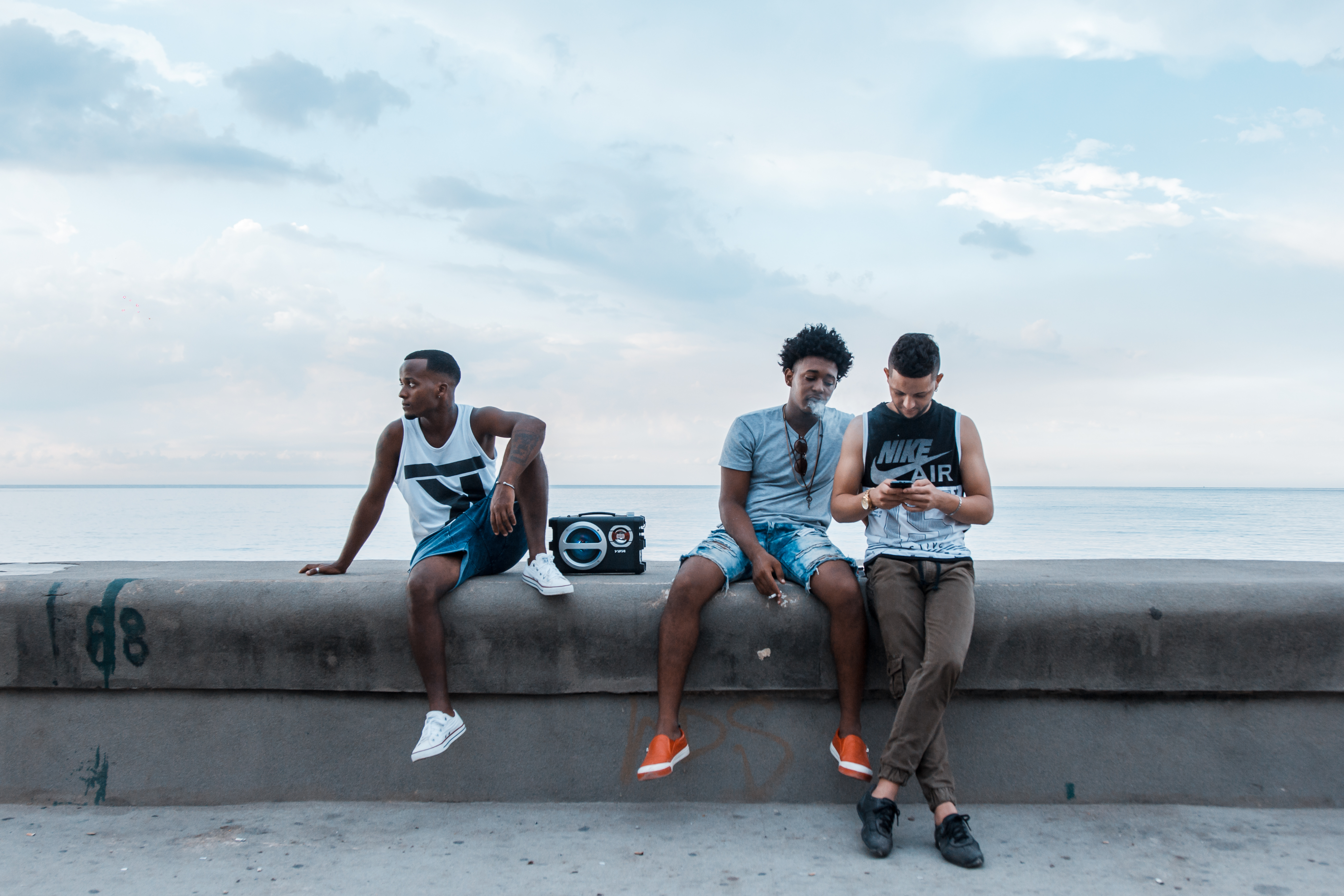
Photographer Paul Chan snapped this photo on the Malecon, in Havana. It was during the Spring quarter of his second year at UC Davis that he studied abroad in Cuba for two and a half months. This would be the first year in which Fidel Castro ceded his presidency to his brother, Raul.

You can see more of Paul’s work at PH-CHAN.com

Leave a comment

A New Revolution Poster

Poster reads:”Every Revolution begins with the power of an idea, but ends when the only idea left is power”

This Poster was created by Camilo Rojas for a project for Common Underground. Foreign designers were asked to choose a word in which their country was paired with and design a poster of their views of that word towards the US.

Designer Camilo Rojas of Spain explains his inspiration: “As a designer I was asked to choose a country (Cuba) and it’s corresponding word (Revolution) and design a poster that depicted their opinion of the two (the word and the country chosen).The basis of the project is to show insight as to how others perceive us and how we perceive others, hopefully this will catch someone’s attention and make them realize that what we need in order to change the course in which we are headed are those positive words that only make things right and focus on the positive instead of the negative.”

Exhibitions of the posters and book were held in Miami art gallery CIFO and also at Miami’s New World School of the Arts in conjunction with AIGA: Miami. A book was published of the project with all of the participating artist photos and bios.

Take a look at the website for Common Underground to see more on this project.

Leave a comment
Follow

Get every new post delivered to your Inbox.

Join 754 other followers